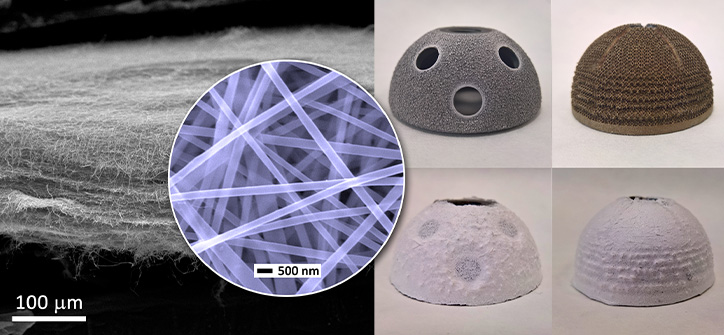
Research activity of the department of composite and carbon materials is oriented to theoretical studies and applications of modern nano-fibre, nano-particle and hybrid composite materials prepared on the basis of synthetic or inorganic materials and materials of organic origin. This activity includes two main directions, first composite materials for medical use on the basis of a biocompatible and biodegradable matrix, and second technical heat resistant composites with a matrix of ceramics.
Composite materials for tissue engineering and medicine The Department of Composites and Carbon Materials works on biomaterials for potential substitutes for both soft and hard tissues, and develops materials that are as similar as possible to natural tissues from the viewpoints of their mechanical and structural properties and material composition. Concerning hard tissues, a focus is paid on the main components of bone, namely collagen and calcium phosphates that are process at the nanoscale at which they occur in natural bone.
1. Isolation, processing and characterization of collagen Collagen, a unique natural polymer with a complex hierarchical structure and outstanding properties, constitutes a potential candidate for the construction of materials for use in the field of bone tissue regeneration. With respect to the limitations imposed by the complex processes applied in the processing of collagen from native tissue to the intended form, its application is limited. It is important that the balance be maintained between the successful processing of collagen into microstructured and nanostructured constructs and the preservation of its unique structure without some degree of denaturation.
2. Calcium phosphate nanoparticles for the repair of bone defects Calcium phosphates (CaP) have traditionally been used for the repair of bone defects due to their strong resemblance to the inorganic phase of the bone matrix. The wide variety of natural and synthetic CaP‐based biomaterials available today are used extensively in dental and orthopaedic applications owing to their high levels of biocompatibility, osteoconductivity and osteoinductivity. Various calcium phosphate calcium phosphates were isolated and utilized in order to obtain a suitable filler for the studied biocomposites. Bioapatite isolated or prepared from biogenic sources exhibits enhanced resorbability and a much higher degree of bioactivity than synthetic calcium phosphates.
3. Collagen-calcium phosphate nanolayers with controlled elution of antibiotics Collagen/calcium phosphate/antibiotic coatings for orthopaedic implants in the form of a nanofibrous layer exerts a strong local anti-infection effect without indication of cytotoxicity and, simultaneously, leads to an increase in the rate of osseointegration necessary for the suitable fixation of the implant. It is expected that such a layer will be used particularly in the case of known prosthetic joint infections or as a preventative procedure regarding primary joint replacement in a potentially infected site.
4. Collagen composite scaffolds for bone surgery Optimal bone replacement materials imitate the real bone composition and structure so as to allow for the functioning of repair mechanisms by providing a temporary porous scaffold that, in turn, provides mechanical support for cells up to the time that the tissue has regenerated and remodelled itself naturally. The application of collagen is problematic due to its poor mechanical properties, high swelling rate in aqueous environments, low structural stability and low level of resistivity to the enzymatic degradation of its untreated laboratory form. We demonstrated that the mechanical and structural properties of collagen can be improved via chemical cross-linking and via the creation of composite materials in which the collagen matrix is reinforced by polymeric fibres or calcium phosphate particles.
5. Collagen porous foams for wound healing Collagen antibiotics-containing foams provide a promising tool for the local treatment and prevention of surgical site infection. Advantage of utilization of fish collagen, isolated from freshwater fish (Cyprinus carpio) skin, remains in lower antigenicity than its mammalian counterparts, low risk of the transmission of ruminant zoonosis, excellent biocompatibility, and promotion of direct cell adhesion and differentiation. Various construction of foams was developed and analysed in combination with different kinds of antibiotics, namely simple homogeneous foams, sandwich foams with variable porosity or composite foams prepared as combination of collagen nanofibrous reinforcement embedded in porous collagen matrix.
Research of preceramic polymers and their use in the development of ceramic foams, ceramic matrix composites and all-ceramic sandwiches The Department also specialises in the development of unique composites for use at elevated temperatures. Such composites are produced from a range of fibres, e.g. basalt, glass and ceramic fibres, and are fabricated using ordinary laminating technology. They are then subjected to high temperatures in an inert atmosphere which significantly enhances their properties. We made particularly significant progress with so-called partially-pyrolyzed composites which are reinforced with basalt fibres. These materials have good mechanical properties and, unlike other fibre-based composites, they also exhibit a high degree of fire resistance.
1. Advanced ceramic foams from a pyrolysed polymer precursor The research of the pyrolysis transformation of polysiloxane thermosets into Si-O-C ceramics is focused on simple basic polymethlylsiloxane and polymethyphenylsiloxane resins. The effects of the pyrolysis process on changes in the chemical structure of the material and on induced changes in mechanical properties at various degrees of this conversion in the range of 250 to 1000 °C have been investigated. Long-term experience with pyrolysis processes and newly acquired knowledge in the field of pyrolysis of polysiloxanes were used in the development of advanced ceramic foams, several principally different methods of cross-linked polymer precursor preparation have been tested, namely expansion of simple low molecular weight hydrocarbon compounds, utilization of epoxy particles as pore-forming templates or adding starch into the thermoset precursor prior its curing.
2. Ceramic sandwich materials The experience with the production of ceramic matrix composites and the knowledge gained in the field of ceramic foam preparation are utilized in the development of sandwich material, all components of which are made of ceramic. A ceramic fibre reinforced composite with a nanocrystalline mullite - corundum structure was used for the outer bearing layers of this sandwich. The matrix of the bearing layers is formed of Si-O-C ceramics. The outer bearing layers were made separately by placing the fibres into a polysiloxane thermoset and its subsequent pyrolysis to 1000 °C. The core of the sandwich is formed of Si-O-C ceramic foam which was prepared by foaming the polysiloxane precursor by the addition of starch and subsequently pyrolyzed to a temperature of 1000 °C. The outer bearing layers were adhered to the foam core with an inorganic silicate adhesive and subsequently the sandwich was annealed to 1000 °C to cure the adhesive.
International Cooperation
Institute of Macromolecular Compounds, Russian Academy of Science, St. Petersburg
Development of tissue engineering materials on the basis of polymer matrices and mesenchymal stem cells, osteoblasts and fibroblasts, (2012-2014), Dr. V.E. Yudin, biomaterials which consist of chitosan and other biocompatible matrices
Dipartimento di Elettronica, Informazione e Bioingegneria, Politecnico di Milano, Milano, Italy
The electron beam irradiation of type I bovine collagen gels: Insights into radiation dose and water content impacts on the composition and the structural, rheological, thermal and mechanical properties
2025
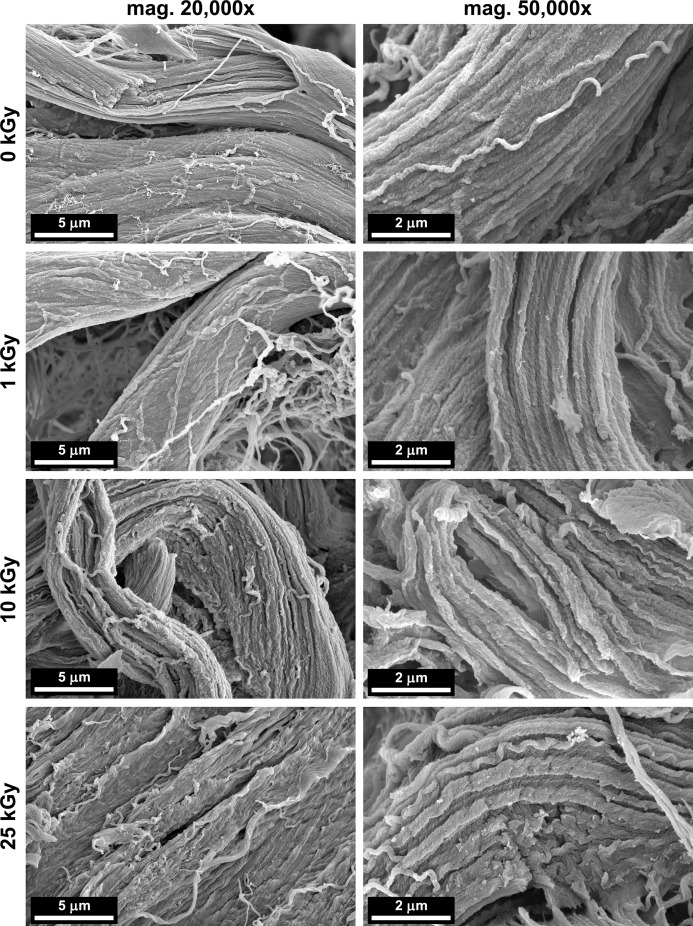
This study examined the impacts of electron beam irradiation (0.25; 0,5; 1; 10 and 25 kGy) on bovine collagen hydrogels at a concentration of 3 wt%. The impact of irradiation was verified via the analysis of the mechanical, thermal and rheological properties, changes in the composition and structure of the collagen, its stability in the enzymatic environment, and its swelling and morphology. Both the degradation and cross-linking of the collagen mass were demonstrated in relation to the radiation dose. Degradation was proven via a decrease in the content of the triple helical part of the collagen and transformation into other collagen structural states, and cross-linking was demonstrated by an increase in the network chain density with the radiation dose. When compared with the non-irradiated gels, no significant qualitative changes in the configuration or ordering over longer distances were evident following the application of the irradiation doses. The apparent elastic modulus, overall thermal stability and rheological characteristics in the oscillatory regime, and the storage and loss moduli of elasticity correlated positively with the radiation dose.
Publication: M. Šupová, T. Suchý, M. Vopálková, P. Novotná, M. Šulc, Z. Hrdlička, M. Houška (2025). The electron beam irradiation of type I bovine collagen gels: Insights into radiation dose and water content impacts on the composition and the structural, rheological, thermal and mechanical properties. International Journal of Biological Macromolecules 320, 146099. https://doi.org/10.1016/j.ijbiomac.2025.146099
Image
Representative SEM images of the collagen gel before irradiation (0 kGy) and the collagen gels irradiated with doses of 0.25, 0.5, 1, 10 and 25 kGy. The images were taken at a magnification of 20,000× (the bar represents 5 μm).
In Vivo Degradation and Local Tissue Response of Experimental Carp Collagen Membranes: Micro-MRI and Histological Analysis
2025
Publication: M. Bujda, T. Suchý, V. Herynek, J. Dušková, M. Žaloudková, L. Šefc, K. Klíma, R. Plachý, R. Foltán (2025). In Vivo Degradation and Local Tissue Response of Experimental Carp Collagen Membranes: Micro-MRI and Histological Analysis. Biopolymers 116, e70045, https://doi.org/10.1002/bip.70045
Characterization of structural properties and non-linear rheological behavior of collagen over a wide range of mass fractions under LAOS
2025
Publication: J. Štípek, H. Rohm, T. Suchý, M. Šupová, R. Žitný, J. Skočilas, M. Žaloudková, M. Houška (2025). Characterization of structural properties and non-linear rheological behavior of collagen over a wide range of mass fractions under LAOS. Polymer Engineering and Science 65(6):3018–3028. https://doi.org/10.1002/pen.27195
Chemotaxonomy according to leaf terpenes of eight cypress species growing in the Czech Republic in the light of modern phylogenetic classification
2025
Publication: A. Malhocká, M. Švábová, T. Suchý (2025). Chemotaxonomy according to leaf terpenes of eight cypress species growing in the Czech Republic in the light of modern phylogenetic classification. Biochemical Systematics and Ecology 120, 104980. https://doi.org/10.1016/j.bse.2025.104980
Effect of Processing on Structural and Morphological Changes of Hydroxyapatite-Based Materials
2025
Publication: L. Klecandová, A. Slíva, M. Šindler, M. Šupová, S. Kumar Sathish, J. Kupková, L. Hružík, K. Lafdi, K. Čech Barabaszová, G. Simha Martynková (2025). Effect of Processing on Structural and Morphological Changes of Hydroxyapatite-Based Materials. ChemistrySelect 10, e202405109, https://doi.org/10.1002/slct.202405109
Degradation of the mechanical properties of poly-lactide-caprolactone-collagen composite for pulmonary artery banding after implantation into a rat's peritoneum
2025
Publication: Horný, L. Vištejnová, T. Suchý, E. Košťáková Kuželová, H. Chlup, J. Kronek, Z. Sobotka, Z. Petřivý, M. Žaloudková, K. Havlíčková, J. Moláček (2025). Degradation of the mechanical properties of poly-lactide-caprolactone-collagen composite for pulmonary artery banding after implantation into a rat's peritoneum. Medical Engineering & Physics 138, 104319. https://doi.org/10.1016/j.medengphy.2025.104319
The Impact of GAGs, Cross-Link Maturity and Telopeptides on the Formation of a Porcine Collagen-Based Hydrogel
2025
Publication: M. Šupová, Š. Rýglová, T. Suchý, M. Žaloudková, M. Braun (2025). The Impact of GAGs, Cross-Link Maturity and Telopeptides on the Formation of a Porcine Collagen-Based Hydrogel. Gels 11, 695. https://doi.org/10.3390/gels11090695
Activated Carbon–Geopolymer Composites: Influence of Particle Size and Content on CO2 Adsorption and Mechanical and Thermal Properties
2025
Publication: D. Řimnáčová, I. Perná, M. Novotná, M. Šupová, M. Nováková, O. Bičáková (2025). Activated Carbon–Geopolymer Composites: Influence of Particle Size and Content on CO2 Adsorption and Mechanical and Thermal Properties. Crystals 15, 892. https://doi.org/10.3390/cryst15100892
Age-related changes in the biochemical composition of the human aorta and their correlation with the delamination strength
2024
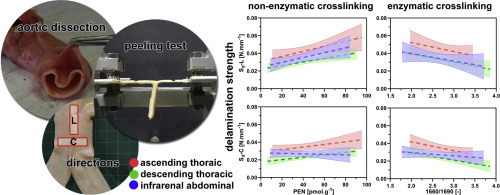
Various studies have correlated the mechanical properties of the aortic wall with its biochemical parameters and inner structure. Very few studies have addressed correlations with the cohesive properties, which are crucial for understanding fracture phenomena such as aortic dissection, i.e. a life-threatening process. Aimed at filling this gap, we conducted a comprehensive biochemical and histological analysis of human aortas (the ascending and descending thoracic and infrarenal abdominal aorta) from 34 cadavers obtained post-mortem during regular autopsies.
Publication: Suchý, T.; Horný, L.; Šupová, M.; Adámek, T.; Blanková, A.; Žaloudková, M.; Grajciarová, M.; Yakushko, Y.; Blassová, T.; Braun, M. Age-related changes in the biochemical composition of the human aorta and their correlation with the delamination strength, Acta Biomaterialia 2024, In Press, Corrected Proof. doi.org/10.1016/j.actbio.2024.11.002
Image
In vivo and in vitro study of resorbable magnesium wires for medical implants: Mg purity, surface quality, Zn alloying and polymer coating
2024
Magnesium is an excellent material in terms of biocompatibility and its corrosion products can serve as an active source for new bone formation. However, localized corrosion and H2 generation limit the potential of Mg-based implants. Utilizing low-alloyed Mg-Zn wires can strongly reduce problems with large H2 bubbles and improve the mechanical properties considerably while maintaining excellent long-term biocompatibility. Acidic pickling and a polymer coating can be effectively used to lower the rate of in vivo degradation. In this work, microstructural, mechanical, and in vitro characterization of 250 µm and 300 µm extruded wires made from ultra-pure Mg, commercially pure Mg, Mg-0.15Zn, Mg-0.4Zn and Mg-1Zn was performed. Additionally, Mg-0.4Zn wires together with a variant coated with a copolymer of l-lactide and ε-caprolactone were tested in vivo on artificially damaged Wistar rat femurs. Based on the observed Mg-induced osteogenesis, polymer-coated Mg wires with a small addition of Zn are a perspective material for bone-support applications, such as cerclage and fixation wires.
Publication: Tesař, K.; Luňáčková, J.; Jex, M.; Žaloudková, M.; Vrbová, R.; Bartoš, M.; Klein, P.; Vištejnová, L.; Dušková, J.; Filová, E.; Sucharda, Z.; Steinerová, M.; Habr, S.; Balík, K.; Singh, A. (2024): In vivo and in vitro study of resorbable magnesium wires for medical implants: Mg purity, surface quality, Zn alloying and polymer coating, Journal of Magnesium and Alloys 2024, 12, 2472-2488. doi.org/10.1016/j.jma.2024.06.003
Image
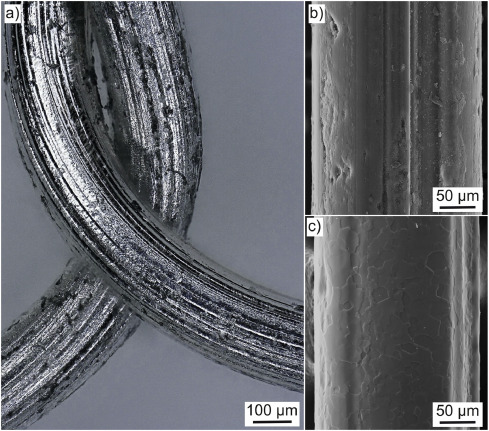
Fig.. a) 3D light microscope image of as-extruded 250 µm Mg-0.4Zn wire b) SEM comparison of the ultra-pure Mg cleaned in acetone and c) cleaned via Nital pickling.
The comparison of eight different common in vitro and ex vivo environments with in vivo conditions applying model collagen samples: Correlation possibilities and their limits
2024
New biomaterials are routinely evaluated for their degradation behaviour in the real body environment. Following the 3R strategy, in vitro simulated body conditions are often preferred. No studies that simultaneously compare such conditions with the real body environment have been conducted to date. Model porous collagen scaffolds were exposed for 21 days to eight different environments: simple salt-based and enzymatic media, human blood plasma, cell culture media with and without human fibroblasts and ex vivomodel cortical bone, and subsequently compared with an in vivo environment represented by a pig peritoneum. The mechanical properties of the scaffolds were then determined via uniaxial compression testing, and the structural properties via the micro-CT, weight loss, infrared spectroscopy, X-ray diffraction and histological methods. Interestingly, the various analysed simulated body conditions caused differing alterations in the collagen scaffold characteristics when compared with the real body environment. The mechanical properties were similar during the first 7 days of incubation but diverged after 14 and 21 days. The structural properties varied significantly after just 7 days of incubation. The histological evaluation of the scaffolds exposed to the cellular, ex vivo and in vivo conditions revealed the poor ability of cells to completely populate the scaffolds, accompanied by the massive ingrowth of connective tissue into the in vivo exposed scaffolds, which resulted in their variable global behaviour. In conclusion, the value of in vitro simulated body environments lies in their screening capacity and feasibility; however, direct extrapolation to real body conditions needs to be verified going forward.
Publication: Suchý, T.; Vištejnová, L.; Sedláček, R.; Vopálková, M.; Šupová, M.; Simha Martynková, G.; Staňo, J.; Klein, P.; Denk, F.; Kužma, J.; Bartoš, M. The comparison of eight different common in vitro and ex vivo environments with in vivo conditions applying model collagen samples: Correlation possibilities and their limits, Polymer Testing 2024, 140, 108621. https://doi.org/10.1016/j.polymertesting.2024.108621
Image
Micro-CT 3D visualizations of representative specimens from each group (bar 5 mm).
Titanium-Doped Diamond-like Carbon Layers as a Promising Coating for Joint Replacements Supporting Osteogenic Differentiation of Mesenchymal Stem Cells
2024
Publication: Trávníčková, M.; Filová, E.; Slepička, P.; Slepičková Kasalková, N.; Kocourek, T.; Žaloudková, M.; Suchý, T.; Bačáková, M. (2024) Titanium-Doped Diamond-like Carbon Layers as a Promising Coating for Joint Replacements Supporting Osteogenic Differentiation of Mesenchymal Stem Cells, International Journal of Molecular Sciences, 25(5), 2837. https://doi.org/10.3390/ijms25052837
Comparative Study of the Dehydrothermal Crosslinking of Electrospun Collagen Nanofibers: The Effects of Vacuum Conditions and Subsequent Chemical Crosslinking
2024
Publication: Kužma, J.; Suchý, T.; Horný, L.; Šupová, M.; Sucharda, Z. Comparative Study of the Dehydrothermal Crosslinking of Electrospun Collagen Nanofibers: The Effects of Vacuum Conditions and Subsequent Chemical Crosslinking, Polymers 2024, 16(17), 2453. https://doi.org/10.3390/polym16172453
Physico-mechanical properties of geopolymers after thermal exposure: Influence of filler, temperature and dwell time
2024
Publication: Perná I., Zárybnická L., Mácová P., Šupová M., Ševčík R. (2024): Physico-mechanical properties of geopolymers after thermal exposure: Influence of filler, temperature and dwell time. Construction and Building Materials 451, 138893. https://doi.org/10.1016/j.conbuildmat.2024.138893
Active Media Perfusion in Bioprinted Highly Concentrated Collagen Bioink Enhances the Viability of Cell Culture and Substrate Remodeling
2024
Publication: Kanoková D., Matějka R., Žaloudková M., Zigmond J., Šupová M., Matějková J. (2024). Active Media Perfusion in Bioprinted Highly Concentrated Collagen Bioink Enhances the Viability of Cell Culture and Substrate Remodeling. Gels 10, 316. https://doi.org/10.3390/gels10050316
New Method for the Production of High-Concentration Collagen Bioinks with Semiautonomic Preparation
2024
Publication: Matějková J., Kanoková D., Šupová M., Matějka R. (2024). A New Method for the Production of High-Concentration Collagen Bioinks with Semiautonomic Preparation. Gels 10, 66. https://doi.org/10.3390/gels10010066
Sandwich and composite collagen sponge for controlled release of active substances, and method of preparation thereof
2023
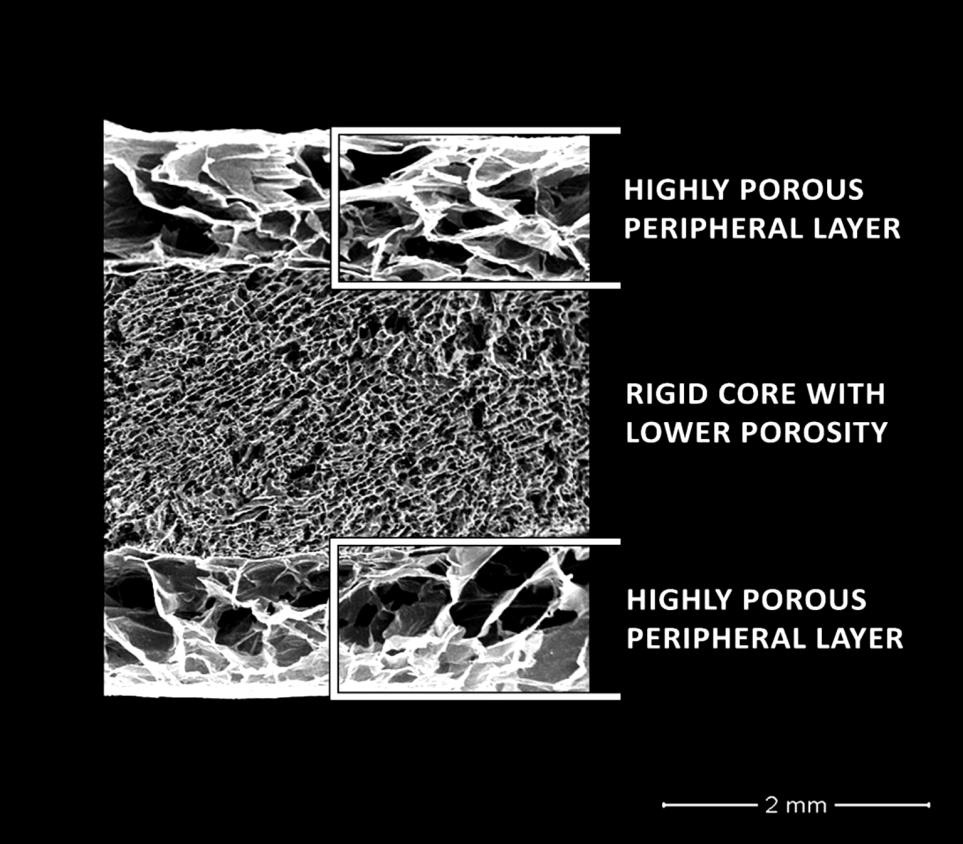
The present invention relates to a method of preparation of a degradable sandwich collagen sponge with hemostatic effects, controlled degradation time and capable of controlled local release of active substances, for example antibiotics for use in wound dressings in surgery, orthopedics, traumatology and plastic surgery, comprising a low porous collagen core and highly porous collagen sponge as peripheral parts.
Publication: T. Grus, T. Suchý, M. Šupová, H. Chlup, J. Hartinger (2023): Sandwich and composite collagen sponge for controlled release of active substances, and method of preparation thereof. EP 3 838 302, European Patent Office, date of publication 23.08.2023.
Image
Fig. Sandwich collagen foam: section with noticeably stiff, low-porosity core and high-porosity boundary layers.
The investigation of batch-to-batch variabilities in the composition of isolates from fish and mammalian species using different protocols
2023
Procedures for processing and analysing collagen samples were evaluated and a study was carried out to provide a comprehensive description of the suitability of different methods of collagen isolation from a wide range of animal species and tissues in terms of reproducibility, quality and composition.
Publication: Š. Rýglová, M. Braun, T. Suchý, M. Hříbal, M. Žaloudková, L. Vištějnová (2023): The investigation of batch-to-batch variabilities in the composition of isolates from fish and mammalian species using different protocols. Food Research International 169, 112798. doi.org/10.1016/j.foodres.2023.112798
Image
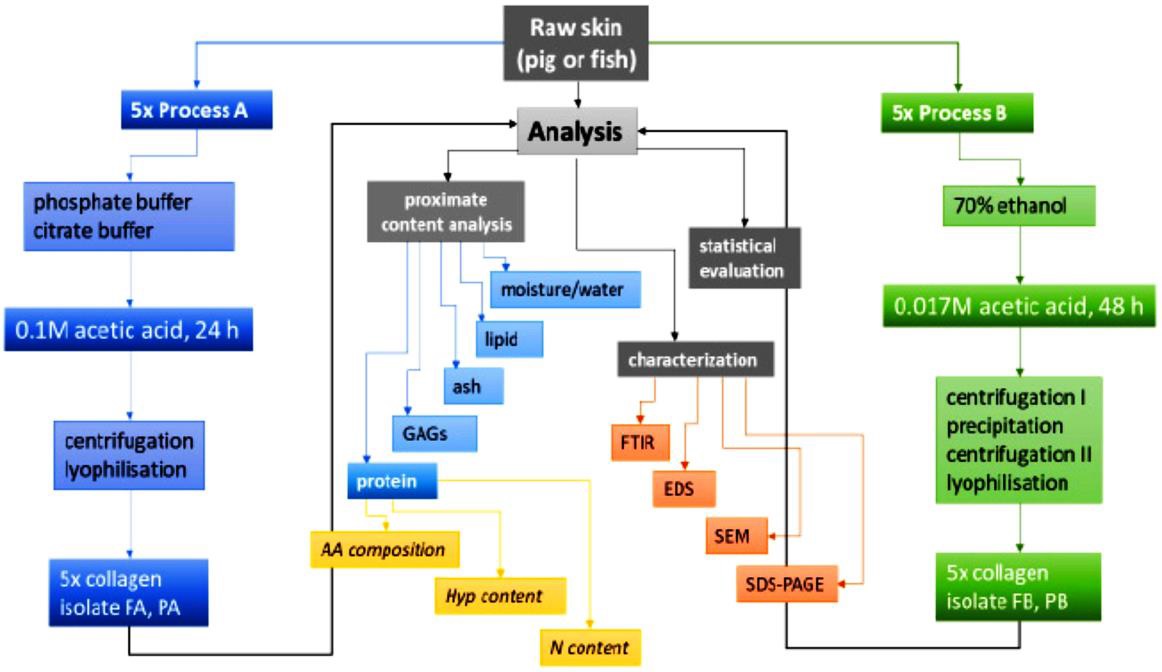
Fig. Scheme of the sample processing and analysis procedure. FA, PA - fish and pig refers to isolates from process A and FB, PB from process B. FTIR - Fourier infrared spectroscopy, EDS - energy-dispersive spectrometer, SEM - scanning electron miscroscopy, SDS-PAGE - polyacrylamide gel electrophoresis. GAGs - glycosaminoglycans, AA - amino acids, Hyp - hydroxyproline.
The electron beam irradiation of collagen in the dry and gel states: The effect of the dose and water content from the primary to the quaternary levels
2023
The aim was to describe the impact of collagen in the gel and dry state to various doses of electron beam radiation (1, 10 and 25 kGy) which are using for food processing and sterilization Irradiation of collagen in different states has different effects: irradiation in the dry state mainly causes the breakdown of collagen molecules; irradiation of the gel with increasing doses causes a change in its mechanical properties, in particular an increase in its elastic modulus. Irradiation increases the cross-linking of scleroprotein molecules (with only partial degradation), but does not alter the composition and morphology of collagen, either in the gel or in the dry state. The result was achieved in collaboration with the Faculty of Mechanical Engineering of the Czech Technical University in Prague, the Food Research Institute Prague, Nuclear Physics Institute CAS Řež and University of Chemistry and Technology Prague.
Publication: M. Šupová, T. Suchý, H. Chlup, M. Šulc, T. Kotrč, L. Šilingová, M. Žaloudková, Š. Rýglová, M. Braun, D. Chvátil, Z. Hrdlička, M. Houška (2023): The electron beam irradiation of collagen in the dry and gel states: The effect of the dose and water content from the primary to the quaternary levels. International Journal of Biological Macromolecules 253 (2023) 126898. doi.org/10.1016/j.ijbiomac.2023.126898
Image
Fig. 6. Representative SEM images of the collagen gel before irradiation (0 kGy) and the collagen gels irradiated with doses of 1, 10 and 25 kGy. The images in the left column were taken at a magnification of 20,000× (the bar represents 5 μm), and those in the right column at a magnification of 50,000× (the bar represents 2 μm).
Adipose-Derived Stem Cells in Reinforced Collagen Gel: A Comparison between Two Approaches to Differentiation towards Smooth Muscle Cells
2023
Publication: E. Filova, M. Šupová, A. Eckhardt, M. Vrbacky, A. Blanquer, M. Trávničková, J. Knitlová, T. Suchý, S. Rýglová, M. Braun, Z. Burdíková, M. Schätz, V. Jenčová, M. Lisnenko, L. Behalek, R. Procházková, R. Sedláček, K. Kubasová, L. Bačáková (2023): Adipose-Derived Stem Cells in Reinforced Collagen Gel: A Comparison between Two Approaches to Differentiation towards Smooth Muscle Cells, International Journal of Molecular Sciences. 24(6) 5692. doi.org/10.3390/ijms24065692
Properties of Bovine Collagen as Influenced by High-Pressure Processing
2023
Publication: M. Houška, A. Landfeld, P. Novotná, J. Strohalm, M. Šupová, T. Suchý, H. Chlup, J. Skočilas, J. Štípek, M. Žaloudková, M. Šulc (2023): Properties of Bovine Collagen as Influenced by High-Pressure Processing. Polymers 15(11):2472. doi.org/10.3390/polym15112472
The electron beam induced cross-linking of bovine collagen gels with various concentrations: The mechanical properties and secondary structure
2023
Publication: H. Chlup, T. Suchý, M. Šupová (2023): The electron beam induced cross-linking of bovine collagen gels with various concentrations: The mechanical properties and secondary structure, Polymer 287, 126423. doi.org/10.1016/j.polymer.2023.126423
The comprehensive evaluation of two collagen gels used for sausage casing extrusion purposes: The role of the structural and mechanical properties
2023
Publication: M. Šupová, T. Suchý, H. Chlup, J. Štípek, R. Žitný, A. Landfeld, J. Skočilas, M. Žaloudková, Š. Rýglová, M. Braun, J. Štancl, M. Houška (2023): The comprehensive evaluation of two collagen gels used for sausage casing extrusion purposes: The role of the structural and mechanical properties, Journal of Food Engineering 343 , 111387. doi.org/10.1016/j.jfoodeng.2022.111387
Exploring the influence of placing bi-directional E-glass fibers as protective layer under a CAD-CAM resin composite on the fracture pattern
2023
Publication: C.M. Saratti, N. Scotti, A. Comba, J. Bijelic-Donova, T. Suchý, M. Abdelaziz, J.G. Leprince, G.T. Rocca (2023): Exploring the influence of placing bi-directional E-glass fibers as protective layer under a CAD-CAM resin composite on the fracture pattern. Dental Materials 39, 986–993. doi.org/10.1016/j.dental.2023.09.003
Reinforced composite hydrogel with cells
2023
Publikace: L. Bačáková, E. Filová, Š. Pražák, I. Vacková, T. Suchý, M. Šupová, J. Šepitka, R. Procházková, V. Jenčová, E. Kuželová Košťáková, M. Lisnenko, D. Lukáš, J. Valtera (2023): Vyztužený kompozitní hydrogel s buňkami. (Reinforced composite hydrogel with cells.) Užitný vzor č.: 37438.
Micro-computed tomography evaluation of bone architecture in various forms of unilateral condylar hyperplasia
2022
Machoň, V.; Bartoš, M.; Suchý, T.; Levorová, J.; Foltán, R.: Micro-computed tomography evaluation of bone architecture in various forms of unilateral condylar hyperplasia. Journal of Oral and Maxillofacial Surgery. 2022, DOI: doi.org/10.1016/j.ijom.2022.05.008
pH Modification of High-Concentrated Collagen Bioinks as a Factor Affecting Cell Viability, Mechanical Properties, and Printability
2021
Stepanovska, J.; Otahal, M.; Hanzalek, K.;Supova, M.; Matejka, R.: pH Modification of High-Concentrated Collagen Bioinks as a Factor Affecting Cell Viability, Mechanical Properties, and Printability. Gels 2021, 7, 252. doi.org/10.3390/gels7040252
Problems associated with the assessment of organic impuritiesin bioapatites isolated from animal sources: a review
2022
Šupová, M.: Problems associated with the assessment of organic impuritiesin bioapatites isolated from animal sources: a review. Journal of the Australian Ceramic Society, 2022, 58 (1), 227 - 247. doi.org/10.1007/s41779-021-00678-y
Slow pyrolysis of waste polyethylene terephthalate yielding paraldehyde, ethylene glycol, benzoic acid and clean fuel
2022
Straka, P.; Bičáková, O.; Šupová, M. : Slow pyrolysis of waste polyethylene terephthalate yielding paraldehyde, ethylene glycol, benzoic acid and clean fuel. Polymer Degradation and Stability 198 (2022) 109900. https://doi.org/10.1016/j.polymdegradstab.2022.109900
a-deficient hydroxyapatite synthesis on the bioapatite bovine bone substrate study
2022
Pazourková, L.; Martynková, G.S.; Šupová, M.: Ca-deficient hydroxyapatite synthesis on the bioapatite bovine bone substrate study. Materials Today: Proceedings 52 (2022) 227–231. DOI: doi.org/10.1016/j.matpr.2021.11.412
Medical device based on bioapatite and demineralized bone matrix for bone defect augmentation
2021
Publication: Wolfová, Lucie - Šenková, A. - Suchý, Tomáš - Šupová, Monika - Karkoška, J. - Forostyak, S.: Medical device based on bioapatite and demineralized bone matrix for bone defect augmentation, 2021: Vlastník: Ústav experimentální medicíny AV ČR. Datum udělení vzoru: 2.2.2021. Číslo vzoru: 34826, Institucionální podpora: RVO:68378041; RVO:67985891
Parent crater for Australasian tektites beneath the sands of the Alashan Desert, Northwest China: Best candidate ever?,
Mechanické zkoušky materiálů při vysokých teplotách
Laboratory of Natural Polymer Processing
The laboratory is focused on the processing of natural and synthetic polymers, especially collagen, its isolation from various types of tissues, processing into micro and nanostructured forms and complex characterization at all levels of its structure. The activities of the laboratory have long been focused on the evaluation of collagen processing processes and the influence of these processes on its final properties. A wide range of analytical methods are used for characterization. A special focus of the laboratory is the electrostatic softening of natural polymers.
doc. Ing. Tomáš Suchý, Ph.D. Ing. Monika Šupová, Ph.D. Ing. Šárka Rýglová, Ph.D. RNDr. Martin Braun, Ph.D. Ing. Miloň Hříbal Ing. František Denk Ing. Ján Kužma Martina Křížková Zbyněk Sucharda